The day my grandfather died, my mother didn’t cry. At three years old, I thought that was what adults did. My mother stood at the doorway to the living room, alone, staring at her father’s body on the wooden bench the whole time we were there. Next to his body were my uncle and my grandmother on their knees, sliding their fingers across the wrinkles on his forehead. On the table sat an open pack of cigarettes. Smoke stained the room, and hot ashes spilled from the ashtray.
I remembered hearing the hearse rev its engine, followed by the husk of father’s voice. He was shouting. A cigarette dangled between his lips. Then came a bunch of other men, who each held a cigarette between their lips, stormed into the house with their shoes on, and carried the body away. My grandmother and uncle followed them, leaving my mother and I behind.
“Mom, there’s dirt on the floor,” I said.
She didn’t react but walked me to her motorbike and put me on the backseat. I held onto her waist on our way home. All she ever said that day was, “His last meal was cigarettes.”
The day after, my mother still didn’t cry. When she took me to the cremation ceremony, she still didn’t cry. At the funeral, she seemed solemn but still didn’t cry. All she ever did was place his portrait on the altar, beside Buddha, and light incense for him every morning.
I saw my mom cry for the first time when I punched my dad for beating me. I was six. My mother didn’t cry when she found out. She took me to her room, and we talked. I reacted. She taught me lessons. I defended myself. We argued. She called me mày. We stared at each other. I cried. Part of my body was contempt — only gangsters and the illiterate used mày tao. How could a woman who gave birth to me say things like that? Another part of me wanted to apologize, even though I knew I wasn’t at fault. There was also pride because I made the strongest woman my family had ever known lose her temper. I glanced at her face before she covered it with her hand. I noticed that she was holding back, too. She slammed the door instead, leaving me alone in her room. When I walked downstairs, she was crying at the dinner table.
For four years, never once was the subject of my grandfather brought up. I had forgotten the scene of the funeral. I hoped it was the same for my mother. One late evening, I saw my dad sleeping on the couch.
“Is the A/C broken?” I asked.
“Your mom locked the door,” he said.
“She’s home?”
My dad had been sleeping on the couch for three nights. The next morning, I saw her for the first time after two weeks. Her eyes were hollow, and veins popped from her arms.
“Can you get me some porridge?” she said to my dad, who was smoking cigarettes on the veranda, and sat down at the family dinner table.
A few minutes later, my aunt arrived, and my mom told me to go to my room.
I ran to my dad instead and watched his purple veins twitch when he flicked the lighter. Smoke slid on his face.
From inside the house, my aunt screamed, “You paid how much?”
“She used a red drape to cover the table. And we went under the table,” my mom said and sniffed. “I closed my eyes, and he was there. And I just cried and cried. I couldn’t stop.”
“But I remembered everything. When we were kids, you know. The day when I got mad and threw the keys at him. You remember?” my mother continued.
“Was mom there?”
“Yes,” my mom said. “But I can’t do anything to my body.”
“Oh my god. What were you looking for, dear?” my aunt said.
My mom didn’t answer.
“What were you looking for?”
Two weeks before, during one of our family dinners, my mom told me she wanted to go to Ha Noi to visit some family members.
I met Nhật Hà when I was eleven, and addicted to watching horror movies even when I would get nightmares from them. We were in the same class but didn’t hang out at all. Everyone in class said she was standoffish: flipping my friends off when they asked her about homework, talking to herself in class, and having a hunched back.
Nhật Hà and I began hanging out when my best friend had a crush on her best friend. We began sitting together during lunch, but still never talked much. Until one day, I saw a black shiny square on her shirt pocket.
“What is that?” I pointed to the square and asked her.
“My grandfather died,” Nhật Hà said.
“But it’s not part of our uniform.”
“You’re a fucking dumbass,” she said.
“What?”
“You still don’t get it?”
“No. What?”
“We have to wear this when someone in our house dies.”
“I didn’t,” I said.
“Because everyone in your house is alive.”
“No. My grandfather passed away when I was three.”
Nhật Hà didn’t answer.
“I’ll ask my mom,” I said.
“You know. I’m a psychic,” she said.
“What?”
“I can see ghosts. I have a sixth sense.”
I doubted her but wanted to talk to her, not because I wanted to talk to ghosts.
“That’s real?” I said.
“Do you want to know how many ghosts there are in this room?”
She closed her eyes and pressed it tight with her fingers.
“There’s one over there,” she said, pointing to the upper left corner of the room. “She’s hanging from the ceiling. There’s one just walking around where the teacher is standing. There’s one in the back of the room looking at us.”
Nhật Hà opened her eyes. No one said a word. I turned around and looked at the teacher, but couldn’t track his voice.
After that, we talked a little more and signed up for clubs together. I told her about my mother the day my grandfather died and her trip to Ha Noi.
“I think one of the relatives was being disrespectful to my mother when she went to Ha Noi,” I said. “That’s why she acted like that. She isn’t usually like that.”
“I think she went to a medium,” Nhật Hà said.
“What?”
“You fucking idiot. She wanted to talk to your grandfather.”
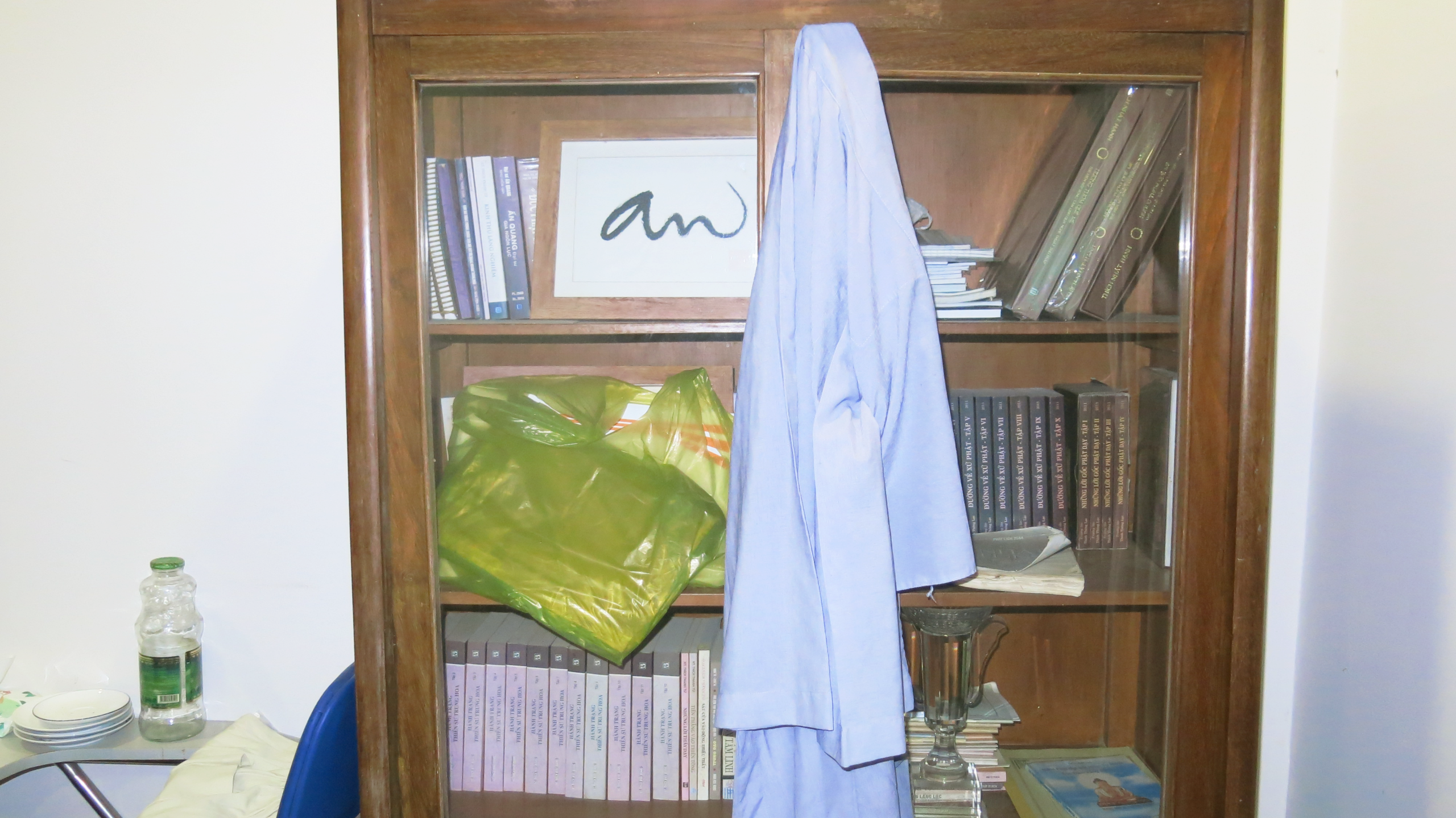
My bedroom was next to the family altar. My mom was the only person who used it. I usually woke up to her chanting in a gray cà sa, and the prayers reminded me of my diary. We were both talking to someone or something invisible. She asked Buddha and my grandfather for our family’s good health. I asked my diary for clear skin.
My dad, my late grandfather, and two of my uncles were heavy smokers, to the point that if smoke didn’t linger in our house every morning, it felt empty. Both my parents said good morning to me under the two lines of smoke fusing into each other. At one point, I couldn’t distinguish which one I should or should not inhale.
Besides being a smoker, my grandfather was also a soldier. He fought in the war as some grand general of the Viet Congs. He met my grandmother in Ha Noi, married her, and had four kids, two boys and two girls, and my mother was the youngest. When the country united, the whole family moved to Saigon, where my parents met.
“I was a brat. I never want to stand on dirt. Never. And back then, there were no shoes. Guess what? I stand on your grandfather’s feet. When he’s tired, I stand on your uncle’s feet,” my mother said. “Like mother, like son.”
“I’m not like that,” I said. “I stand on my own feet.”
“You reap what you sow,” my grandmother said.
My grandmother rarely spoke of her husband. All I knew about her relationship with my grandfather was that she refused to sell the motorbike he gave her as a wedding gift, even when the brakes had worn out and the right rear view mirror had broken while she was riding through a speed bump.
“She’ll bite you if you try to sell it,” my mother continued. “Don’t play with her dentures.”
The room went silent. I looked over at my mom.
She looked at me, then burst out laughing. I laughed, too. Then I thought of my grandfather — if he were here, he would’ve laughed, too, would he?
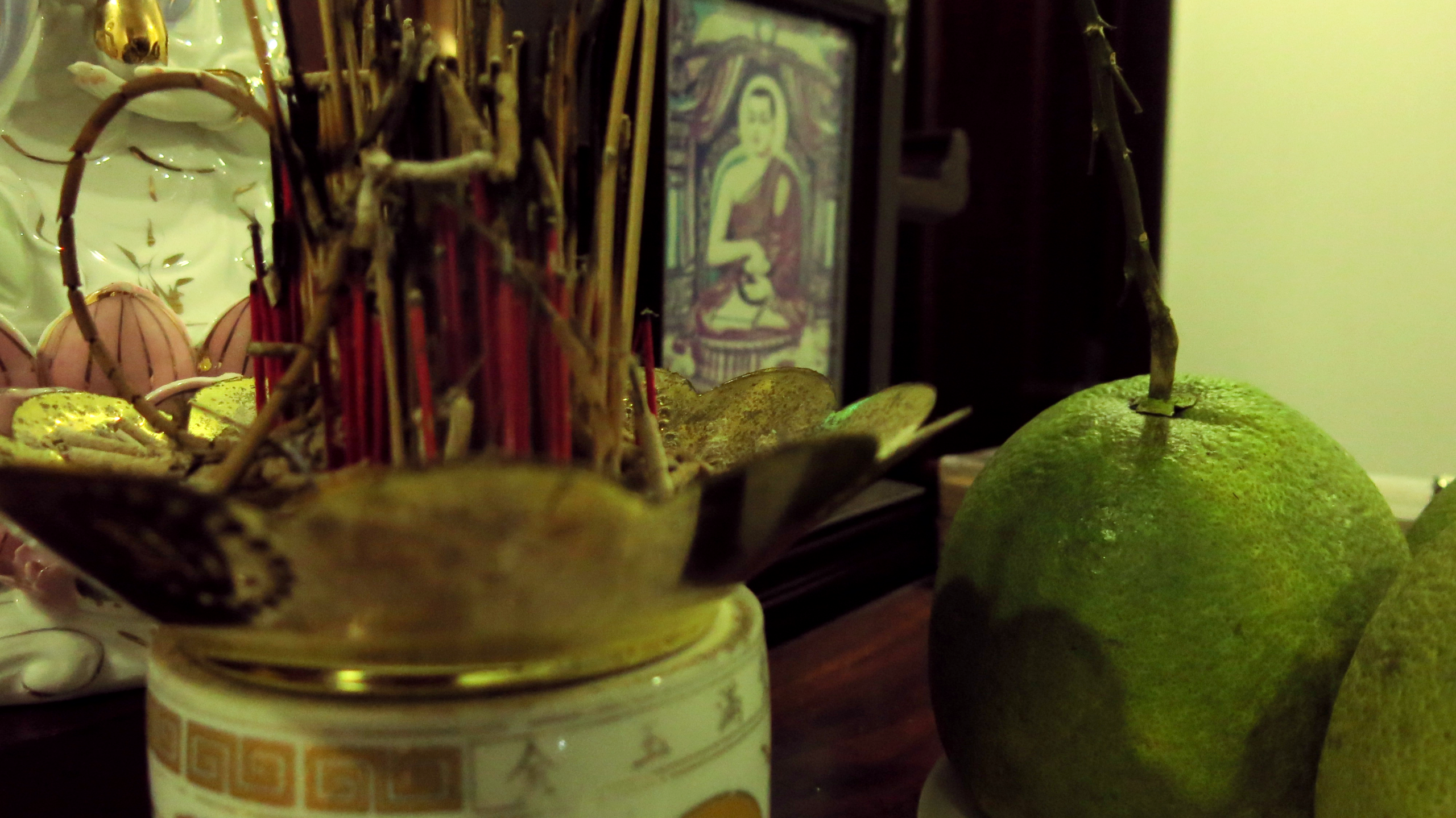
Sleeping alone scared me even when I was fifteen, grown enough to lie to my parents about smoking with my friends on a school trip. I hated being alone, and sleeping alone felt like sitting at the same table with my friends, sipping on iced tea while they took drag after drag of the same cigarette. One of the jokes that my mother told me, which I took too literally, was that ghosts came to get naughty kids. I felt guilty for smoking. And so I joined my mother in the penance chant every full moon at our local temple, the one that kept my grandfather’s ashes. We would stop by his remains and pray after our visits.
“Ask him to be by your side,” she said to me.
“But he’s dead,” I said.
“So, for example, if you want good grades while taking a test, you ask him to help you get good grades.”
“But if I want to get good grades, I have to study, right?”
“You never know. He will always be by your side. I always feel him here.”
She also taught me to never blow on incense but shake it until the fire dies. She’d stand beside me, watching as I pressed the incense into the bowl of ashes. I sniffed as the smoke curled. Then we’d walk to my father, who also came with us but didn’t want to come inside. He’d rather wait on the sidewalk and smoke instead.
“Stop smoking,” my mother said when she saw my dad.
My father didn’t answer.
“It causes cancer,” I said. “You know what?”
“What?” my mother said.
“My friends vaped. You remember the one that you bought for that when you wanted him to quit smoking? My friend has the same one.”
“I told your dad, but he doesn’t listen. Look at your grandfather. Black lungs. Your grandmother found him coughing up blood. Took him to the hospital. Too late. He came home and waited for death. He paid for death.”
Outside, honking was constant. Inside, the smell of incense and cigarettes surrounded us.
“Turn on the A/C, dad,” I said. “It smells horrible.”
Our family organized Grandfather’s đám giỗ every year. I knew it was sometime in March, but I couldn’t remember the exact date. I didn’t think any of us did, except for grandmother. She usually did all the work: cooking, assembling, and praying. Everybody else ate and left. But she had to see our faces.
A boiled chicken with its head and feet centered the tray. There was xôi gấc, chè bắp, and fruits. Except for the chicken, those things could change depending on what my grandmother had in her fridge. But there was always one thing that my grandmother never missed: three packs of cigarettes. I always imagined how my grandfather would smoke in heaven. The altitude? The wind? Or he must be here with us somewhere, smoking and eating in the invisible realm. Because why are we doing all of this — the food, the prayers — if it would all end up in the trash can? Would it be better to commemorate him in silence, in our minds? I mean, if he could see us doing all of this, he would know that we think about him, too, right?
But that was the way it had always been. Every household I knew has been doing giỗ. Yet, no one can explain why. My mother said it felt empty if we didn’t do anything for my grandfather. I agreed even though I didn’t know him that well.
“He would have loved you the most if he were alive,” my mother said.
“Why?” I said.
“You were the smartest. You get good grades,” she said. “He loved kids with good grades.”
I tried to imagine his face.
“He loved me the most out of his kids because I had good grades,” she said.
“What does he look like in real life?” I asked her.
“Him? He has a big forehead. I do, too,” she said. “You do, too. You kinda look like him.”
I didn’t know if we could speak of the dead this way. But if my mother did it, it must be okay.
There were mornings when my mom woke up with tears in her eyes and a smile on her face.
“I saw your grandfather last night,” she said.
My dad’s telephone rang. He grabbed his cigarette and went outside.
“What did he say?” I asked.
“He asked me about you. He said ‘I wanted to take you đi chơi,’” she said.
I didn’t know what to say. I looked away as my mother wiped the tears from her eyes with her thumb.
“What do you want for dinner?” she asked.
“Um,” I said.
“It’ll just be the two of us. Your father can live on smoke.”
We all did. He just never knew it could damage his lungs.