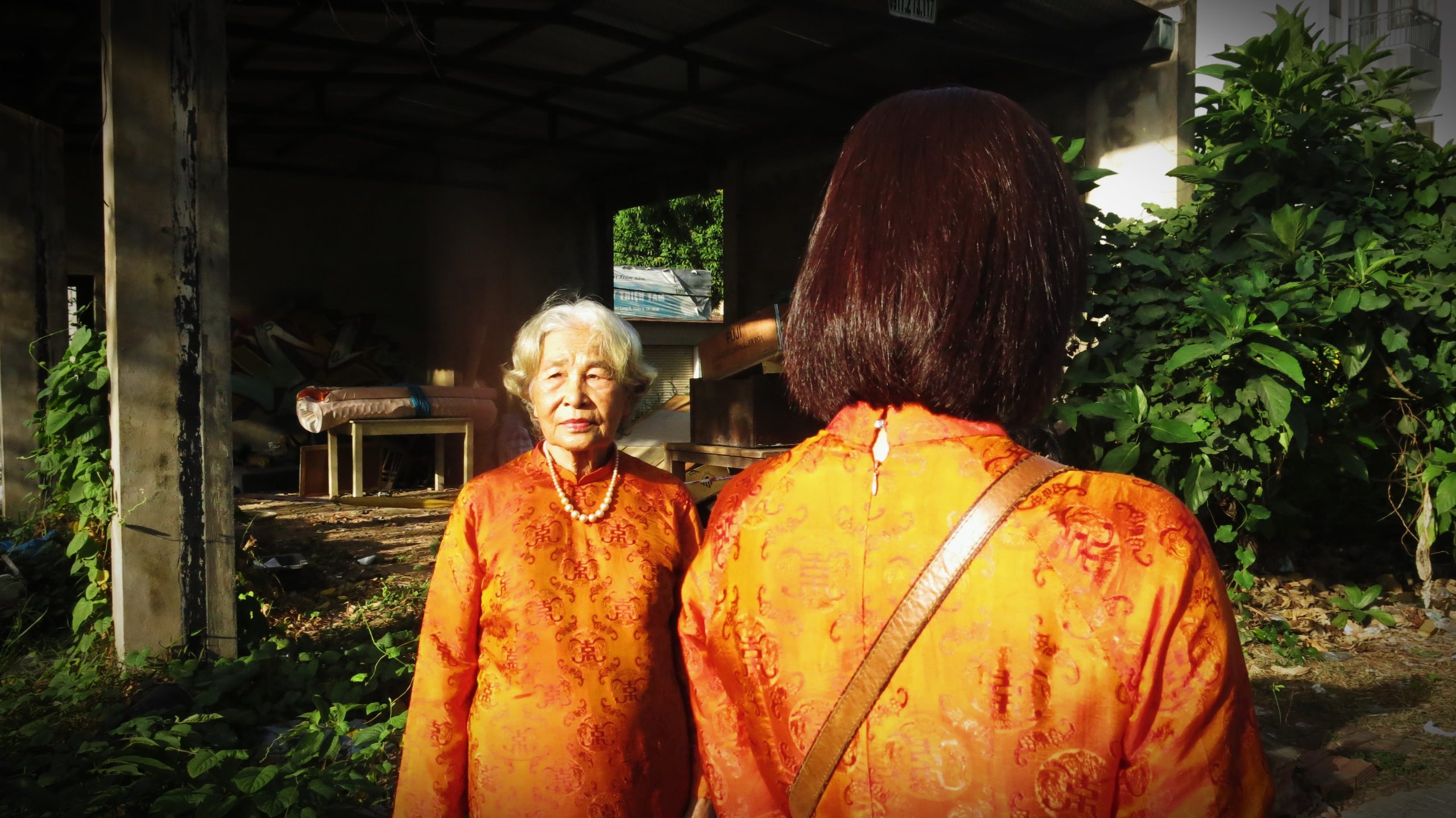
The first time I wore áo dài was when my nanny put it on me for a family photoshoot. I was six. My family drove two motorbikes — my dad and brother were on one, my mother, nanny, and I were on the other. The midday sun poured lava on us. I told my nanny that the brocade smelled like saliva. She said, “This is expensive. This is silk.” The photographer told me to pose as a noble and my brother as my fisherman. After that, my parents joined in. While we were laughing and smiling at each other’s awkward poses, my nanny sat on the bench in the corner of the studio, folding our jeans.
Her name was Chí, but I called her Vú, which in Vietnamese means a woman’s breast in a childlike and loving way. After the war, nannies often breastfed babies when the mother could not provide enough milk. Vú was ten years older than my mom and came from the Mekong region. We knew her from Aunt Kathy’s husband, a Cantonese man with a gambling addiction and a lot of money. When Vú heard about Aunt Kathy’s plane ticket to the United States, she panicked. Two days later, she offered to help my mom during her first pregnancy for a little less.
Like most Vietnamese, Vú had at least one áo dài. Hers was dark purple, almost pitch black, with a lotus lined with pearls on the lower part of the tunic and a crew neck for comfort. The first time I saw her in an áo dài was at my brother’s eighth birthday party at a seafood restaurant downtown, where the bigger the size of the family, the higher the status. Vú paired her áo dài with ruby sandals with faux rhinestones on the straps — the one my brother and I bought for her on our trip to Malaysia (our aunt gave us 100 ringgits to spend at the night market before our flight. We used 70 for her sandals. On the bus to the airport, she cried because no one bought gifts for her mother, not even her kids. I felt guilty and bought my grandmother a keychain at the airport). Big and happy families, like ours, filled the restaurant’s lobbies. The other dads showed off their muscles with skin-tight pants, polos — Korean style, and big watches. The women wore floral dresses or skirts with Mary Jane flats. At our table, Vú talked about the same story that she told at every family dinner: the one time I peed myself in kindergarten, the day my mother gave birth to my brother, and the pink bathtub that she bought for me. When she opened the crab, she put some meat in my bowl, looked around, and suddenly went to the restroom. Vú returned with a napkin and placed it on her knees. She pulled her chair closer to the table, letting the tablecloth fall over her robe. Vúdidn’t talk until we were home. That was our family’s last night out with her in Ho Chi Minh City. A year later, when we were about to leave for our cousin’s birthday, I asked if she was coming.
“My back hurts too much,” she said.
“Why?” I said, dragging my voice. “Drink more milk.”
I left her a cup of milk on the kitchen island and jumped into the car.
It took me only five years to realize that Vú was the only one wearing áo dài in the restaurant that night.
Vú grew up in Trà Vinh but loved Ho Chi Minh City more than her hometown. While my Ho Chi Minh City was ten-year-old kids who only had one arm selling lottery tickets, Q-tips, and peanuts to businessmen, hers was still Saigon, where she could ride her bike without a ruck puncturing the tires. Her only critique was that Saigon had become more expensive, but it was only to start a conversation rather than an argument. Every chance she had, she would invite her kids to the city. Her first daughter, Diễm An, came to work for us when my brother was born. After three years, Diễm An got married at Vú’s home in Trà Vinh. She invited us without a card.
When our family arrived, the thick haze from the grilled pork greeted us. We found Vú in the kitchen, squatting in her purple áo dài and cracking the coconuts for the juice. She gave each of us a glass.
“Sit at the gift table while I help Vú clean the kitchen,” my mom said.
Sweat dripped from my armpit to the split of my áo dài. I finished my coconut juice in half an hour and searched for Vú when nature called.
“I want to poopoo,” I said, pulling her tunic.
“I’m busy as hell,” Vú said as she wiped the sweat on her forehead. “Come on.”
She walked me to a boat in the backyard, untied it from a coconut tree, and rowed down the canal. We arrived at what looked like a platform built over a pond, with metal sheets raised to waist level. Vú took off my áo dài, stood behind me, and laughed as I squatted.
Two years later, when Diễm An opened a café, her younger daughter, Thuỳ An, came to help her. Every Tet, she took my brother and me to Vú’s house, where the government had installed a toilet and tiles. My life switched from sleeping on a mattress in an air-conditioned room to a pallet under a mosquito net and a thatched roof. My brother slept with Thuỳ An. I slept with Vú. And when she woke up at four to light the kitchen fire with coconut husks, I would follow her. At six, she took me to the market, where the stench of fish and chicken blood plagued the air, on her bike.
“You sit here and finish your breakfast while I grab some fish,” she said. “Want something to drink?”
“I want to come,” I said.
“But you don’t like the smell of fish.”
I turned away.
“Come,” she said.
As we trudged through the vendors, buying mustard greens, papaya, and sugar cane juice, mud crept onto my sandals and into my toenails.
“You want new sandals?” Vú said.
“No,” I said.
“You were tiptoeing.”
On our way home, we stopped at a shoe vendor.
“Which one?” Vú said.
“I want blue,” I said.
“They’re too small.”
I looked at Vú’s pink flip flops turning into the color of clay and felt like crying.
“Let’s get the brown one,” Vú said to the vendor.
She bent down, took my muddy sandals from my feet, and slipped them into a plastic bag. I put on my new sandals.
In the afternoon, Vú would show me how to lure catfish with a duck. Then I would make her tag along with me when I flew a kite in the rice field next to her house. At night, I would sell Pepsi and Red Bull while dealing cards. I spent seven days a year soaking in the smell of fish, shooing away mosquitoes, and dodging cow’s poop on the road. Then, five days. Then three. Then Vú’s son ran away to sea from a gambling debt, and I stopped visiting.
Our family moved to a new house when I was twelve. It was three times bigger than our rented one. The second and third floor was lined entirely with Hinoki wood. One afternoon, when I came home from school, I heard my dad complaining to Vú about the dirty floor.
“You gotta mop along the grains of the woods,” my dad said. “It’s still full of dust.”
“My back hurts,” Vú said. “There’s some papaya in the kitchen. You eat and I’ll mop the floor.”
The same conversations went on for a year, but there was never an argument. Only the jokes and stories at family dinners became shorter and sparser. My dad and Vú came up with a cleaning schedule. On days when I didn’t have homework, I would help her mop the floor so she could finish her job on time. I thought working less would put less strain on her back. One afternoon, after my piano lesson, my dad took Vú to the hospital.
Her bed lay next to a window with a view of my elementary school. Her skin reeked of eucalyptus oil.
“When can you come home?” I asked when I snuck onto her bed.
“The doctor said tomorrow night,” she said. “But I can walk now. The medication works.”
I stood by the rail and watched the IV.
“Vú, eat this,” my brother said as he handed her the congee that we bought on our way to the hospital.
“You don’t have to do that,” Vú said. “Have you had dinner?”
“No,” I said.
She wrapped her palm on my thigh.
“I’m going home to Trà Vinh,” Vú said. “Diễm An is pregnant again. Ngọc is going to kindergarten.”
That night, I excused myself from dinner and did my homework. Before bed, I went to see if Vú’s áo dài was still in her closet.
We came to visit Vú when her second daughter got married. We found Vú in the same áo dài, carrying ice in the same kitchen.
“Two done,” my mom said. “Two more to go.”
“Ooh. I don’t know what they’ll do,” Vú said. “But I’m beat.”
“Lucky me, I only have two,” my mom said. “When will these bums get married?”
“Tell your mom, ‘Whatever will be, will be,’” Vú said to me.
“You look good,” my mom said. “A few years younger.”
“Look at my belly fat,” Vú said. “Where’s your áo dài?”
“It’s too hot,” I said.
Sweat darkened the seam under Vú’s armpit.
“I run around all day and I still wear mine,” Vú said.
I frowned.
“Help Vú carry the ice,” my mom said.
That was the last time we saw Vú on her feet.
I never knew the disease that Vú had was called osteoporosis until we visited her when I was 19. I’ve only heard of it in commercials and had to read about it on my phone. Vú had been lying on the same bamboo mat for the past five years. She only got up to help her daughter pick the dead leaves off the mustard greens to sell at the morning market. Her shin was protruding from her sagging skin.
“Let me see,” Vú said as her hands slid on my cheeks. My mom told her that I’d had work done to my face. “What have you got
“A laser peel,” I said. “You don’t have to sit up.”
“You’re already so pretty,” she said. “Why would you need anything done?”
I sipped my water.
“I’m sorry. I didn’t cook anything,” Vú said. “My back hurts so much I can’t walk.”
Vú had had three cages in her spine to replace the shrunken bones. But she still moaned every time she shifted her weight.
“I still keep your bedsheets and bathtub,” she said as she pointed to the ceiling.
The bedsheets I had when I was five were distorted Tom & Jerry figures on a striped background. Vú used it to soak up the water that leaked from the roof. In the backyard, next to the coconut husks, clothes filled the pink bathtub she bathed me in when I was two. There was a line where soapy water had worn the bathtub lighter.
Her first daughter, Diễm An, came from the back door, carrying a basket of mustard greens. Gray hair poked through her pajamas. She had turned forty last month.
“Oh. You’re so handsome,” Diễm An said as she traced her wet hands on my hair and kissed it. “How’s your job?”
“He makes a thousand a month,” my mom said. “About 25 million.”
Diễm An placed her mustard greens on the table.
“That’s what I made in five years,” she said, wiping her tears.
She took my mom by her arms and dragged her to the door. “Don’t let Vú get too emotional. The doctor said her heart is getting weaker, too.” she whispered.
My mom sipped her green tea. Her eyes were red. My dad excused himself to check out the papaya farm.
Vú slept in the kitchen because it was easy for her to grab water. I wandered into her bedroom, now her grandkids’, and opened the closet. The purple áo dài hung on a distorted hanger. The dust had collected on the pearls. But it still smelled like saliva. On the bottom of the closet, the ruby sandals sparkled. Lying next to them were the brown sandals that she bought me.
Last summer, my mother and I made a one-hour drive to an áo dài shop 7 miles away from our home (my mom was afraid of driving among motorbikes in Ho Chi Minh City; we could’ve taken the bike, but I didn’t want to be in the sun). I saw a kid with one arm selling lottery tickets on the streets — something unmistakably and tragically Saigon. Then I thought of Trà Vinh: the fish, the rice field, the cows. It was like looking at a dreamlike painting: pleasurable, nostalgic, solemn, and dignified. Somehow, the thought of me living there again made me want to vomit. “Do you like this shade of blue?” my mom said. “It makes your skin brighter.” I wanted a traditional áo dài — the one made out of three or four layers of silk that twirled in the wind when I walk, with no shoulder seam, and loose around the waist. I arrived, tried it on, and paid. There was no pressure. For the first time, I craved the silk that hugged my chest. I craved the button that poked my armpit. I craved the parting that showed my waist. My privilege was getting to choose áo dài among polos, jeans, and suits. For most Vietnamese, like Vú, áo dài was never an option. It was the only extravagance they knew.