
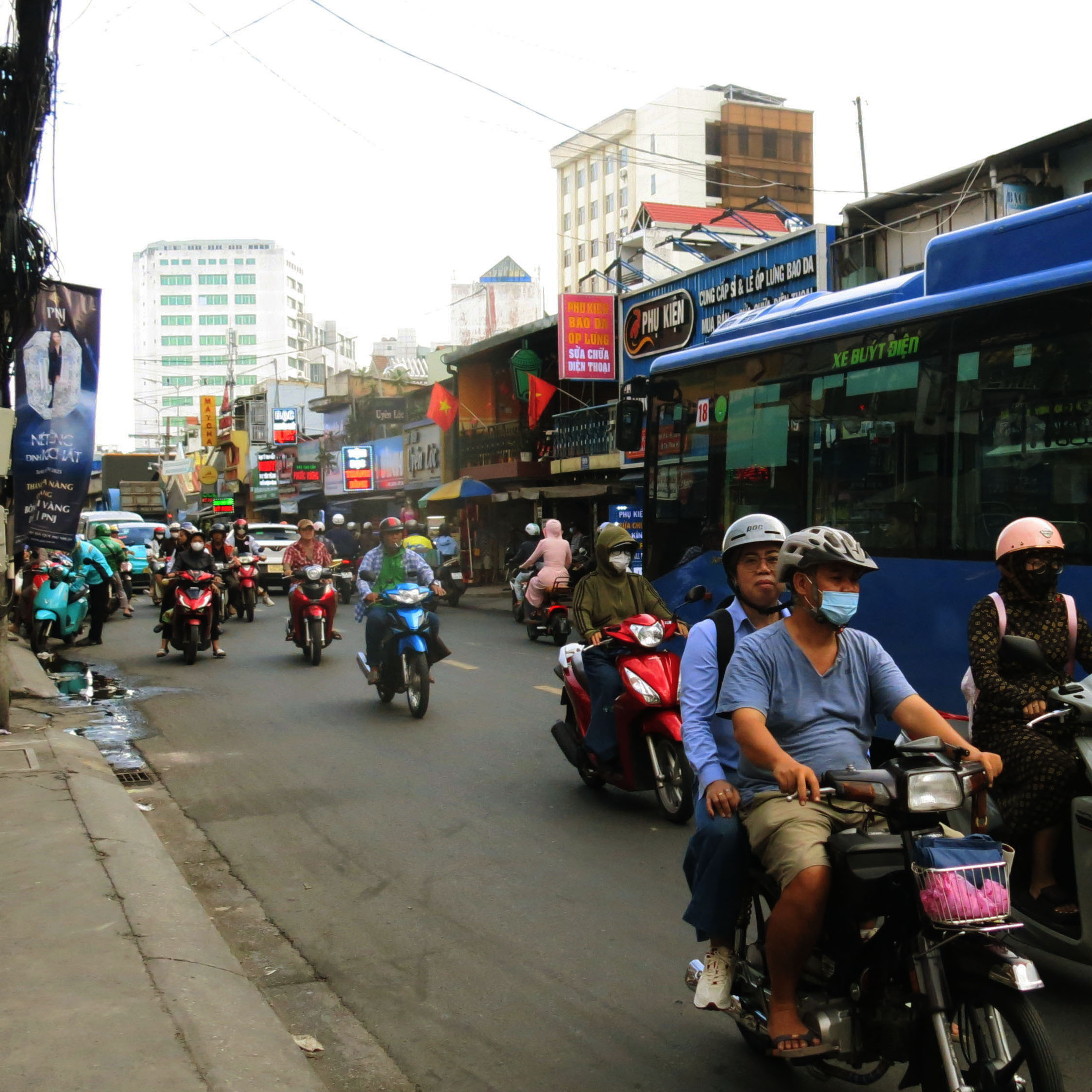
At 5:30 am, I sat on my dad’s motorbike as we crammed through the flock of other motorbikes, buses, cars, and pedestrians on Võ Nguyên Giáp Street. He turned off the engine and pushed the bike with his legs through the spaces between the cars at the red light — all while honking as if we weren’t in the wrong lane.
When I was fifteen, I moved to North Vancouver, Canada, for high school. A fine of up to $281 was the penalty for honking. Cars stayed in the same lane even when there was heavy traffic. The only sound one would hear from the sidewalk was the engine and birds chirping. The silence and the order were admirable. But when I returned to Vietnam each summer, the horns turned more and more loathsome. By the time I learned how to drive in the United States, my dislike had hardened into hatred. On New Year’s Eve, a Jeep Grand Cherokee honked at me when I didn’t hit the gas the second the light turned green. I took a deep breath, rolled down my window, and gave them my middle finger. Since then, I needed to do the same thing every time someone honked at me.
In the 1980s, newscasters at KTLA in Los Angeles used the term “road rage” to describe a series of freeway shootings. The term only gained wider use in the late 1990s, and “road rage” then meant any driving-related aggressions. Headlines like “‘Road Rage’ Takes a Turn for the Worse” (Los Angeles Times 1997), “‘Road Rage’ Versus Reality (The Atlantic 1998), and “Woman Gets 13 Years of Road Rage Shooting” (ABC News2000) made the phrase inevitable. According to The Zebra, a Texas insurance company, 96% of American drivers have witnessed road rage. 40% have witnessed honking out of anger — the highest out of all aggressive driving behaviors. One out of two drivers admits to responding to aggression with aggression of their own.
And yet none of this explains my dad’s behavior. In Vietnam, I began riding my family’s PCX more as I became more confident with my driving skills. I didn’t honk at first, which gave me the impression that I was more educated than the average driver. But when someone honked at me, I would turn around and yell at them. My dad was different. He never cursed or nagged when someone honked at him or cut him off. I asked him why at family dinner. My brother wanted to know the answer, too. “I don’t know,” he said and lit up a cigarette.
On a stormy night, when I was on my way home from piano practice, a woman on a pink LEAD was honking nonstop on Cầu Sài Gòn. Her bike was working just fine, but she didn’t move. All the other bikes slowed down around her. People looked, but no one intervened. She kept honking. Drops of rain jabbed my skin and soaked into my shirt. When I was almost out of the traffic jam, a car drove close to her left. A few seconds later, another drove by her right. The three of them began moving together — ten kilometers per hour, then twenty. They flanked her to shield her from the wind. When I left the traffic jam, the gusts hit me hard. I thought of the pink LEAD lady. But I was too scared to honk.
Even when it is 40 degrees Celsius, gas and dirt stain the road, and horns rupture my eardrums, I have never seen someone get off their bike to throw a punch or roll down the window and flip a finger. People honk, switch lanes, cut each other off, and move on. It only took me twenty years to realize that honking isn’t aggression. It’s language. And my dad isn’t an exceptional driver. He drives the only way he knows.
